
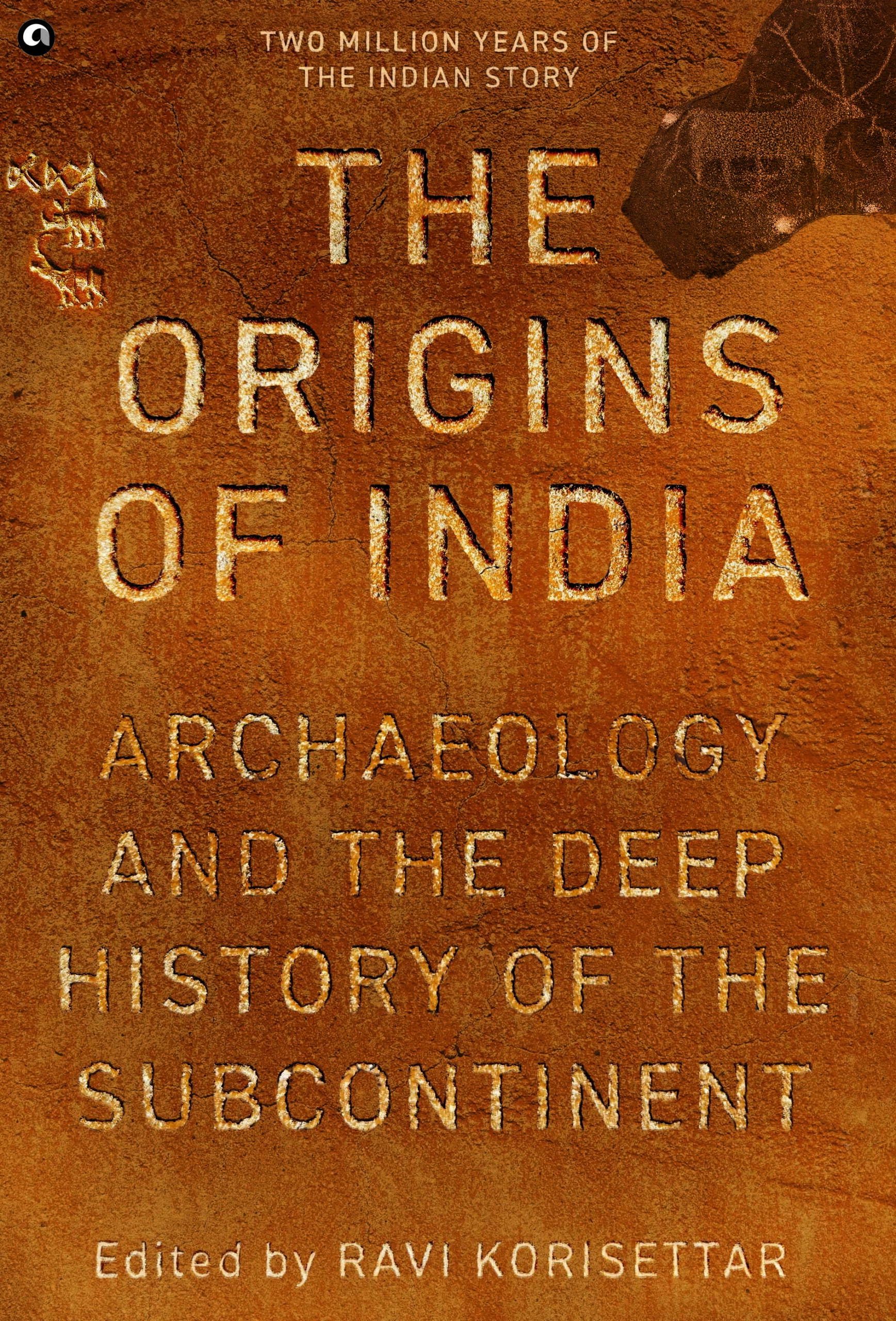
The Origins of India is a sweeping and deeply ambitious volume that reimagines the subcontinent’s past through the lens of archaeology. Collecting essays written by about fifty of the finest archaeologists working today, the book brings together cutting-edge research and fresh interpretations to illuminate India’s deep and complex past—from prehistoric man to the Indus Valley Civilisation and beyond.
The book is organised into four sections that together trace the current state of archaeological research in South Asia. Section I serves as an introduction, opening with a discussion on how new dating techniques are reshaping timelines and interpretations.
Section II focuses on current issues and debates in the world of Indian archaeology, with chapters ranging from Denisovan populations and early human history to stone tools, ancient technologies, prehistoric cultures, and archaeology of regions like Ladakh. It also covers early food production, ashmounds, rice domestication, and protohistoric agriculture, alongside discussions on megaliths, endangered archaeological sites, and the challenges of working with archival data.
Section III turns towards the Indus Valley Civilisation and its wider context, examining urban complexity, climate debates, trade networks, the Lothal dockyard, chariot burials at Sanauli, the question of the horse, Aryan origins, and mortuary practices. In Section IV, the book talks about transitions to early history, with chapters on chronology in Tamil Nadu, the Iron Age, early cities, urbanisation in the Ganga plains, literacy and the Mauryan period, and looks at sites such as Muziris, before concluding with a reflective afterword on contested timelines and contemporary debates.
The essays in this volume offer a layered and nuanced account of India’s past. They resist the facile sophistication of politicians and suspect historians who are trying to weaponise history and archaeology to serve their own agenda. Instead, the essays in this volume, taken together, show how the country’s deep past was complex, vibrant, often shifting, and not easily classifiable.
Ravi Korisettar is an archaeologist and Adjunct Professor at the National Institute of Advanced Studies, Bengaluru, and Honorary Director of the Robert Bruce Foote Sanganakallu Archaeological Museum, Ballari. He was formerly a professor of archaeology at Karnatak University, Dharwad. He is the author of Quaternary Environments and Geoarchaeology of India, Early Human Behaviour in Global Context, Indian Archaeology in Retrospect (four volumes), and Beyond Stones and More Stones (four volumes). He co-edited the landmark volume, The Indians: Histories of a Civilization with G. N. Devy and Tony Joseph.
Read More